

ERP built for textile & apparel manufacturers
From fabric lots to finished garments — track shades, sizes, job work and every metre of material across your unit, without spreadsheets.
The problems textile units bring to us
Shade & lot confusion
Fabric from different lots gets mixed at cutting, causing shade variation complaints and costly returns.
Size-colour SKU sprawl
One style becomes 24 SKUs. Excel can't tell you which size-colour is overstocked and which is sold out.
Job work black hole
Material sent for dyeing, printing or stitching disappears from view — returns, wastage and bills go untracked.
Everything a textile unit needs, in one system
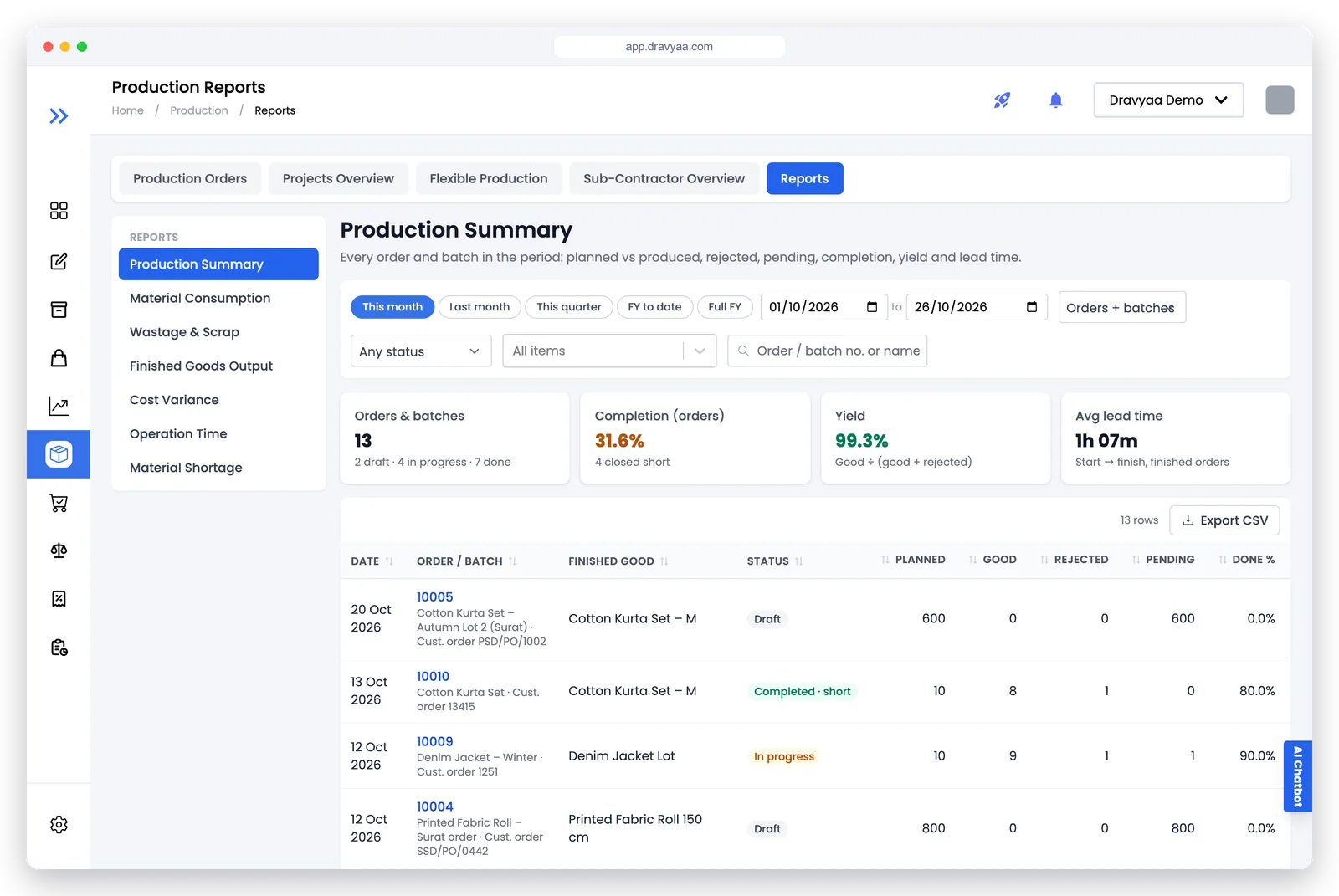
Lot & shade tracking
Every fabric lot carries shade, GSM and supplier details from GRN to finished garment.
Size-colour variants
Manage styles with size and colour matrices — stock, pricing and reorders per variant.
Job work & subcontracting
Track material at dyers, printers and stitching units — challans, returns and wastage included.
Cutting-to-stitching BOMs
Style-wise BOMs with fabric consumption, trims and accessories — WIP visible at every stage.
GST billing & e-invoicing
GST invoices, e-way bills and job work challans — compliant by default.
AI demand insights
Spot which styles, sizes and colours are moving — and reorder fabric before the season peaks.
Less guesswork, fewer write-offs
- ✓Trace any garment back to its fabric lot in seconds — shade complaints get resolved with data.
- ✓See exactly what's at each job worker, for how long, and what it's costing you.
- ✓Stop over-cutting: live size-colour stock prevents producing what's already piled up.
- ✓Close the season with accurate costing per style, not estimates.
Common questions from textile manufacturers
Can Dravyaa track fabric by lot, shade and roll?
Yes. Batch/lot tracking means every fabric lot carries its shade, GSM and supplier details. Issue specific lots to cutting and trace any finished garment back to the fabric it came from.
How does Dravyaa handle size-colour SKU combinations?
Manage style-wise items with size and colour variants — a single style with 6 sizes and 4 colours stays organised as related SKUs, with stock, pricing and reorder points per variant.
Does Dravyaa support job work and subcontracting?
Yes. The subcontracting module tracks material sent to dyers, printers and stitching units, expected returns, wastage and job worker bills — with GST-compliant delivery challans.
Is Dravyaa GST-compliant for textile billing?
Yes. Dravyaa generates GST invoices, e-invoices and e-way bills, and keeps your books ready for GSTR filing — including job work documentation under GST rules.
Going live in 30 days: how a textile unit is set up
The same four steps every Dravyaa customer follows — a mid-year cutover is fine, as long as the opening balances are taken on the cutover date. Case study: going live mid-year with clean opening balances shows it on a real tenant.
Week 1 — masters
Import items, customers and vendors from CSV; registered parties are pulled by GSTIN so names and addresses come from the GST portal, not retyped. Set up fabric lots, shades and size-colour SKUs, warehouses and GST rates.
Week 2 — opening position
Load opening stock per warehouse at cost and party-wise debtor and creditor balances as at the cutover date (the same figures as the previous system's trial balance). Bank and cash opening balances go in last.
Week 3 — BOMs and parallel run
Enter the active BOMs and routings, run one week of real purchases, production and sales alongside the old system, and compare stock, GST and party statements line by line.
Week 4 — go-live
Freeze the old system on the cutover date, remove the demo data, hand each user their role, and file the first GSTR-1 and GSTR-3B from Dravyaa's books.
Guides and case studies for textile manufacturers
Modules textile units use most
See Dravyaa on your styles & fabrics
A 20-minute walkthrough with your own SKUs, lots and job workers.